
When water appears inside a commercial building after heavy rain, it’s easy to assume the roof itself has failed.
But sometimes, the roofing membrane isn’t the problem.
A commercial roof can perform properly across thousands of square feet while one small opening around an HVAC unit or other rooftop penetration gives water a way inside.
These transitions are protected by carefully installed flashing, membranes, sealants, and other waterproofing details. When those components begin to deteriorate or separate, a relatively small defect can become the source of a persistent—and sometimes difficult-to-diagnose—roof leak.
Understanding why rooftop equipment curbs are vulnerable can help building owners catch problems before moisture spreads beyond the original repair area.
Commercial roofs frequently support HVAC units, exhaust fans, vents, ductwork, and other mechanical equipment.
An equipment curb is a raised structure that supports this equipment while providing a transition between it and the roofing system. The roof membrane and flashing are integrated with the curb to help maintain a watertight barrier around the opening.
Similar waterproofing details are required around other rooftop penetrations, including:
Each time something passes through or interrupts the continuous roof surface, additional detailing is required to keep water out.
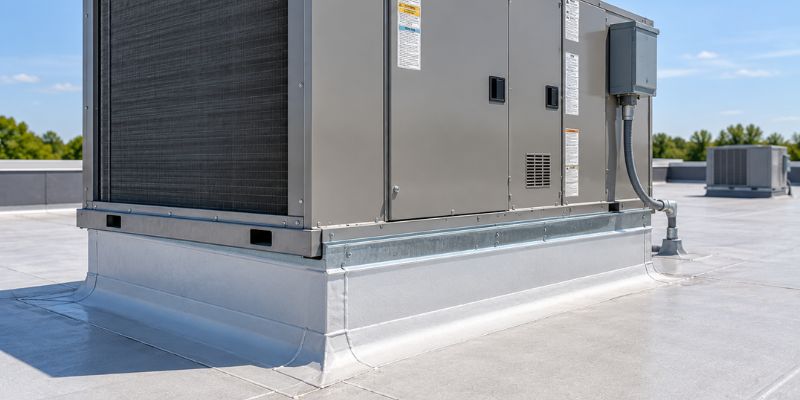
The open field of a commercial roof is relatively straightforward. Equipment curbs introduce something different: corners, seams, vertical transitions, terminations, and changes in plane.
These areas also experience movement.
Roofing materials, metal components, and mechanical equipment can expand and contract as temperatures change. Over years of exposure, that repeated movement can place stress on the details connecting the roof to the equipment curb.
A small separation may not look particularly concerning, but waterproofing depends on all of those components continuing to work together.
When one detail fails, water may find a path beneath the roofing system.
Several conditions can contribute to deterioration around rooftop equipment.
Roof membranes, sealants, and flashing components are continually exposed to sunlight, rain, snow, ice, and temperature fluctuations. Over time, materials can deteriorate and lose their ability to maintain a watertight transition.
Heating and cooling cause building materials to expand and contract. Repeated movement can stress flashing, seams, corners, and membrane terminations.
Equipment curbs require careful integration with the surrounding roofing system. Poorly executed flashing details or incompatible materials can create vulnerabilities that lead to premature problems.
HVAC units and other rooftop equipment require routine maintenance, meaning technicians regularly work in these areas.
Tools, equipment panels, materials, and foot traffic can occasionally disturb nearby roofing components or cause accidental membrane damage.
Water that repeatedly collects around an equipment curb can increase exposure at already vulnerable transitions. Ponding water near rooftop equipment may also indicate a drainage condition that deserves further evaluation.
A slight separation in flashing or a deteriorated sealant joint might only measure a fraction of an inch.
The moisture that enters through it doesn’t necessarily stay there.
Once water gets beneath the roofing membrane, it may migrate into surrounding materials. Depending on the roof system and duration of exposure, that moisture can potentially contribute to:
Not every curb deficiency will result in widespread damage. But the longer water has an opportunity to enter the system, the greater the potential for a localized issue to become more extensive.
That’s why catching these problems early matters.
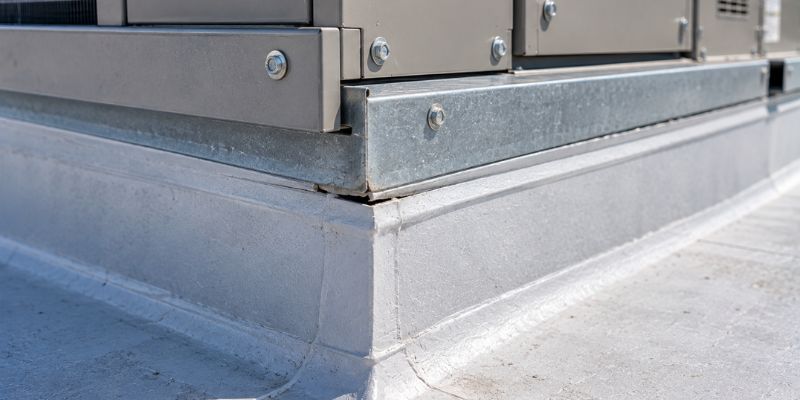
One of the challenges of diagnosing commercial roof leaks is that water doesn’t always travel straight down.
Moisture entering around an HVAC curb may move through insulation, along the roof deck, or around other building components before it finally becomes visible inside.
That means the ceiling stain you see may be several feet away from the actual point of entry.
Simply repairing the roof directly above an interior stain may not solve the problem if the water is actually entering somewhere else.
A thorough inspection helps trace the problem back to its source rather than addressing only the visible symptom.
Some equipment curb problems can be difficult to spot without a professional evaluation, but building owners and facility managers can watch for several warning signs.
These include:
Even relatively minor changes around these areas deserve attention, particularly if the roof has a history of unexplained leaks.
Rooftop HVAC systems require maintenance, repair, and eventually replacement. That means technicians from several trades may access the roof throughout its service life.
This doesn’t mean service work will damage the roof. It simply creates another good opportunity to verify that the surrounding roofing system remains intact.
After significant HVAC installation, replacement, or service work, a roof inspection can check for:
Identifying a small issue immediately after the work is completed is much easier than trying to diagnose an unexplained leak months later.
Not necessarily.
A leak doesn’t automatically mean the entire roofing system has reached the end of its service life.
If the surrounding roof remains in serviceable condition and the source is isolated to an equipment curb or penetration, a localized repair may be appropriate.
Depending on the condition, repairs could involve:
The appropriate solution depends on the roofing system, the condition of surrounding materials, and how far any moisture has traveled.
Finding the problem early generally gives building owners more options.
Commercial roofing systems aren’t just large expanses of membrane. They’re made up of transitions, penetrations, flashing, seams, drainage components, and other details that all have to work together.
Routine inspections and preventative maintenance provide an opportunity to evaluate these vulnerable areas before small deficiencies turn into active leaks.
At Mansuetto Roofing & Sheet Metal, we understand that long-term roof performance often comes down to getting the details right. Our team helps commercial building owners identify problems around equipment curbs, penetrations, flashing, and other critical transitions and develop practical repairs that protect the roofing system as a whole.
If you’re experiencing an unexplained roof leak—or have recently had significant work performed on rooftop equipment—a professional inspection can help determine whether a vulnerable curb or penetration is the source.
Because sometimes the roof isn’t leaking. One small detail around the equipment is.
Learn more about our roof maintenance services.